

Is Myrtle Beach Headed for a Housing Crash? Here's the Honest Answer
📊 Market Analysis • Grand Strand September 2026
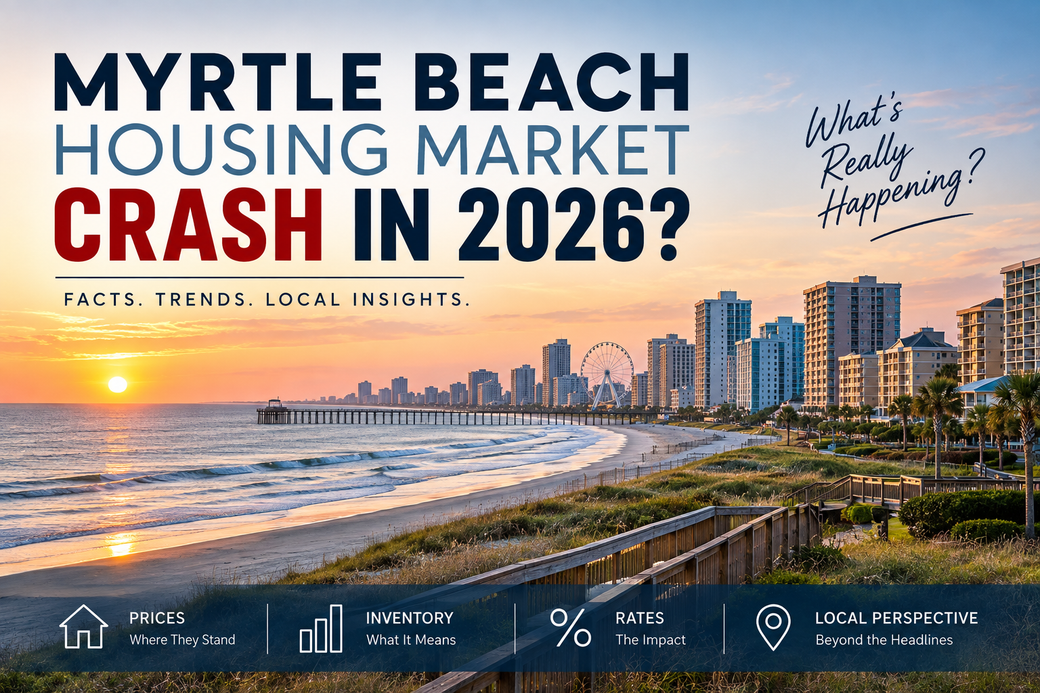
Is Myrtle Beach Headed for a Housing Crash?
Is Myrtle Beach Headed for a Housing Crash?
Here’s the Honest Answer.
The headlines are loud. The local data tells a different story.
Is the Myrtle Beach Housing Market Going to Crash in 2026?
No. The Grand Strand is not headed for a housing crash. What we are seeing is a healthy correction after several years of extraordinary price gains — a normalization, not a collapse. Closed sales are actually up 5.4% year-over-year as of Q1 2026, the median sale price dipped a modest 2.3% from $549,450 to $537,000, and single-family homes remain in seller-favorable territory at 4.8 months of supply. That is not a crash. That is a market finding its footing.
The national crash headlines that are circulating right now do not reflect coastal South Carolina fundamentals. The Grand Strand has 13 million annual visitors, a sustained influx of retirees and East Coast relocators, and a structural demand story that inland overbuilt markets simply do not have. This post breaks down exactly what is happening locally — by property type, by market, and by what it actually means for buyers, sellers, and investors right now.
The national crash headlines that are circulating right now do not reflect coastal South Carolina fundamentals. The Grand Strand has 13 million annual visitors, a sustained influx of retirees and East Coast relocators, and a structural demand story that inland overbuilt markets simply do not have. This post breaks down exactly what is happening locally — by property type, by market, and by what it actually means for buyers, sellers, and investors right now.
📋 Grand Strand Market Reality Check — September 2026
| METRIC | WHAT IT ACTUALLY SHOWS |
| Closed Sales | Up 5.4% year-over-year Q1 2026 — buyers are still buying |
| Median Sale Price | $537,000 Q1 2026 — down 2.3% from $549,450 in Q1 2025. A correction, not a crash. |
| Price Per Sq Ft | Down 8.1% — reflects more condo and smaller unit closings in the mix, not pure price decline |
| Active Listings | ~2,640 across the Grand Strand — elevated but not historic |
| Days on Market | 64–144 days depending on property type and neighborhood — longer than 2021–2023, not unusual historically |
| Single Family Supply | 4.8 months — still seller-favorable territory (under 6 months) |
| Condo Supply | 7.8 months — buyer’s market; softest segment on the Strand |
| New Construction Supply | 2.8 months — most competitive segment; builders moving homes with incentives |
| Annual Visitors | 13 million — underlying tourism demand that does not disappear in a correction |
Source: Coastal Carolinas Association of REALTORS® Q1 2026; RPR® August 2026. All figures approximate.
Let’s Define Terms
⚠ What Does a Housing Crash Actually Look Like vs. What We Have?
The word “crash” gets used loosely in real estate headlines. It’s worth being precise about what it actually means — and what it doesn’t.
| A CRASH MEANS | WHAT WE ACTUALLY HAVE |
| Prices falling 20–30%+ | Median price down 2.3% year-over-year. That’s a rounding error compared to 2008. |
| Forced selling & foreclosures rising sharply | No foreclosure surge. Sellers with equity are choosing to wait rather than capitulate. |
| Transactions collapsing | Closed sales UP 5.4% year-over-year. Buyers are still buying. |
| Demand disappearing | 13 million annual visitors, sustained retiree inflow, East Coast relocators still arriving. |
| Overleveraged buyers defaulting | 2024–2026 buyers came in with stronger equity positions than 2006–2007 buyers. |
What we have on the Grand Strand is a market normalizing after one of the most extraordinary run-ups in real estate history. Prices rose dramatically in 2020–2022. They are now finding a more sustainable level. That is a correction. It is not a catastrophe. These are genuinely different things and conflating them costs buyers and sellers real money in real decisions.
Local vs. National
🌊 How Is the Grand Strand Market Different From the National Housing Market?
The national headlines about housing are written about national averages — which means they reflect overbuilt Sun Belt suburbs, speculative markets with thin demand fundamentals, and inland metros where the post-pandemic relocation surge has fully reversed. The Grand Strand is none of those things.
|
🏖 Structural Demand
13 million tourists visit the Grand Strand every year. Retirees continue arriving from the Northeast and Midwest at sustained rates — drawn by South Carolina’s tax structure, the cost of living advantage over Florida, and 60 miles of Atlantic coastline. That inbound demand does not pause during a correction.
|
💰 The Tax Advantage
No state tax on Social Security. Property assessed at 4% of market value. $50,000 homestead exemption for residents 65+. Effective property tax rate around 0.57%. These structural advantages make the Grand Strand comparatively more attractive every time other coastal markets raise costs.
|
|
|
⛳ Lifestyle Supply
100+ golf courses. 60 miles of beach. Year-round outdoor lifestyle. Brookgreen Gardens. The MarshWalk. Proximity to both Charlotte and Charleston. These are not replicable assets. Markets with genuinely irreplaceable lifestyle supply tend to be more resilient than those without it.
|
📉 Correction, Not Reversal
Home prices on the Grand Strand rose 40–60% in some communities between 2020 and 2023. A 2–8% correction from those levels is not a reversal of the underlying trend — it’s a pause. Most sellers who bought before 2022 still have substantial equity even after the correction.
|
💡 The Florida comparison: Much of the national crash conversation is driven by specific Florida markets where insurance costs have spiraled, condo reserve requirements have created forced selling pressure, and speculative investor activity is unwinding. South Carolina’s insurance market is more stable, our condo regulation environment is different, and the Strand’s buyer demographic skews toward owner-occupants and lifestyle buyers rather than speculative investors. The dynamics are materially different.
The Three Markets
🎯 Why Are There So Many Homes for Sale in Myrtle Beach Right Now?
Inventory is elevated — approximately 2,640 active listings across the Grand Strand. But the “why” matters, and so does where those listings are concentrated. The Grand Strand is not one market right now. It’s three — and they are telling very different stories.
| SEGMENT | SUPPLY | MARKET TYPE | WHAT’S REALLY HAPPENING |
| Single Family Resale | 4.8 mo. | Seller-Favorable | Holding up well. Below the 6-month balanced threshold. Correctly priced homes still moving. |
| Condos & Townhomes | 7.8 mo. | Buyer’s Market | The softest segment. Insurance concerns, HOA costs, and new construction competition all weighing on demand. Buyers have real leverage here. |
| New Construction | 2.8 mo. | Most Competitive | Builders controlling pace with rate buydowns and closing cost incentives. The competition that resale sellers need to price against. |
The elevated inventory story is heavily concentrated in the condo segment. Single-family resale is not in crisis — it’s in a buyer-favorable correction. New construction is actually the most competitive segment on the Strand right now, which is telling you something important about underlying demand: builders are moving homes, just with more financial persuasion than they needed in 2022.
The price-per-square-foot figure dropping 8.1% is also a composition story more than a pure price story. When more condos and smaller units close relative to large single-family homes, the blended median price per square foot moves down even if no individual home type has declined that much. It’s an artifact of the sales mix — and conflating it with a broad 8% price decline misrepresents what’s actually happening in the market.
For Buyers
🏠 Is Now a Good Time to Buy in Myrtle Beach?
Yes — and this is genuinely one of the better buyer windows the Grand Strand has seen in years. Not because prices are crashing, but because the conditions have shifted meaningfully in buyers’ favor across most of the market.
✔ More inventory to choose from
~2,640 active listings means buyers are not competing with five offers on the same home. You have time to look, compare, and think. That didn’t exist in 2021 or 2022.
✔ Negotiating room that didn’t exist before
Closing cost credits, home warranties, price flexibility, and longer due diligence periods are all available now. Sellers who have been on market 60+ days are motivated. Ask for concessions — you will get some.
✔ Builder incentives adding real value
New construction buyers are getting rate buydowns, $30,000–$50,000 in closing cost assistance, and upgrade packages that weren’t available during the peak. If new construction fits your lifestyle, the current incentive environment is exceptionally favorable.
⚠ The “wait for prices to drop more” risk: Buyers who waited in 2013 and 2014 for more drops after the 2008 correction paid meaningfully more when they finally bought in 2016. Nobody rings a bell at the bottom. The buyers who win in corrections are the ones who buy when conditions are favorable — not the ones who wait for the absolute lowest price that may or may not come.
For Sellers
🏷 Are Home Prices Dropping in Myrtle Beach — and What Does That Mean If I’m Selling?
Prices have modestly corrected from their 2022–2023 peaks in most segments. That doesn’t mean sellers can’t sell — it means sellers need to be realistic about where the market is now, not where it was.
Price correctly from day one
With days on market ranging from 64 to 144 and 79% of active listings having already had a price reduction, the market is sending an unambiguous signal: sellers who test high are sitting while sellers who price right are closing. The first two weeks of a listing generate the most buyer traffic. Overpricing that window away is a costly mistake in the current environment.
Invest in presentation before listing
Buyers are comparing your resale home against brand-new construction with $40,000+ in closing cost incentives. Condition and presentation are the differentiators. Professional photography, clean presentation, and addressed deferred maintenance are not optional — they are the price of entry for a competitive listing right now.
Be realistic on concessions
Closing cost credits, home warranties, and flexible closing dates are what buyers in this market are asking for. A deal closed with a 2% concession is almost always better than sitting unsold for another 90 days. Conway sellers hitting 98.5% sold-to-list did it by meeting buyers halfway — not by refusing to budge. That’s the model.
For Investors
💸 Will Myrtle Beach Home Prices Recover — and Is It Worth Holding?
The long-term investment thesis for Grand Strand real estate remains intact — and the current correction does not change that thesis in any meaningful way.
|
📊 Historical Resilience
Coastal real estate with strong tourism demand has historically been one of the most resilient asset classes through market corrections. The 2008–2012 cycle saw coastal South Carolina recover faster and more completely than inland markets. The underlying demand drivers — tourism, retirement inflow, lifestyle appeal — did not disappear then and they are not disappearing now.
|
🏨 Short-Term Rental Demand
13 million visitors annually need places to stay. That number does not pause in a correction. Properties in communities that permit short-term rentals — Barefoot Resort, Myrtlewood, select Myrtle Beach condo communities — continue generating rental income through market cycles in ways that inland investment properties cannot.
|
For investors considering entering the market: the current correction is precisely the environment where long-term coastal acquisitions make sense. You are buying at a meaningfully lower price than the 2022 peak, into a market with structural demand support, in a state with favorable tax treatment, at a time when sellers are motivated and builders are offering incentives. Those conditions rarely align simultaneously. They are aligned now.
Our Local Angle
🤝 What We Actually See in the Grand Strand Market Every Day
We are in this market every day across all seven Grand Strand communities. We are not reading national headlines and guessing at what they mean locally — we are watching what actually closes, what actually sits, and what buyers are actually doing in Myrtle Beach, North Myrtle Beach, Murrells Inlet, Pawleys Island, Conway, Little River, and Longs in real time.
What we see: correctly priced homes are selling. Buyers are active and motivated, especially in the fall window we are in right now. The communities with the strongest fundamentals — Carolina Forest schools, Pawleys Island lifestyle, the Murrells Inlet Hammock Coast character — are holding value better than the commoditized condo segments that national headlines are most likely describing. The crash narrative does not match the ground-level reality we see in contract activity and showing traffic every week.
What the crash narrative gets right: the easy money era is over. Sellers who bought in 2020 expecting 2022 appreciation rates to continue indefinitely are being corrected. Buyers who missed the peak and are holding out for 30% declines are likely to be disappointed. The market has normalized to a place that rewards preparation, honest pricing, and local knowledge over speculation and wishful thinking. That is not a bad place for the market to be.
What we see: correctly priced homes are selling. Buyers are active and motivated, especially in the fall window we are in right now. The communities with the strongest fundamentals — Carolina Forest schools, Pawleys Island lifestyle, the Murrells Inlet Hammock Coast character — are holding value better than the commoditized condo segments that national headlines are most likely describing. The crash narrative does not match the ground-level reality we see in contract activity and showing traffic every week.
What the crash narrative gets right: the easy money era is over. Sellers who bought in 2020 expecting 2022 appreciation rates to continue indefinitely are being corrected. Buyers who missed the peak and are holding out for 30% declines are likely to be disappointed. The market has normalized to a place that rewards preparation, honest pricing, and local knowledge over speculation and wishful thinking. That is not a bad place for the market to be.
Want the Honest Picture for Your Specific Situation?
Whether you’re a buyer, seller, or investor — the broad market numbers only tell part of the story. Your specific neighborhood, property type, and price range may look very different from the aggregate data. Let’s talk through what it actually means for you.
No pressure. Just a straight answer from someone who works this market every day.
FAQ
❓ Questions People Are Searching Right Now
Is the Myrtle Beach housing market going to crash in 2026?
No. The data does not support a crash scenario for the Grand Strand in 2026. Closed sales are up 5.4% year-over-year, the median sale price has declined a modest 2.3%, and single-family homes remain in seller-favorable territory at 4.8 months of supply. A crash requires forced selling, foreclosure surges, and demand collapse — none of which are present in current Grand Strand data. What we have is a market correction after an extraordinary run-up, with elevated inventory and longer days on market. That is a normal post-cycle adjustment, not a crash.
Are home prices dropping in Myrtle Beach?
Modestly, from peak levels. The Q1 2026 median sale price was $537,000 — down 2.3% from $549,450 in Q1 2025. Price per square foot is down 8.1%, but that figure reflects a composition shift toward more condo and smaller unit closings rather than a uniform 8% decline across all home types. Single-family home prices have held up better than the blended average suggests. In some communities — Pawleys Island, Longs, Murrells Inlet — specific segments have seen price appreciation even as the broader market softened.
Is now a good time to buy in Myrtle Beach?
Yes — conditions are genuinely more favorable for buyers than they have been in years. More inventory (~2,640 active listings), motivated sellers, negotiating room that didn’t exist during the peak, and significant builder incentives on new construction all work in buyers’ favor. The fall 2026 buyer pool on the Grand Strand is the most favorable environment since 2019. Buyers who have been waiting for conditions to improve — they have improved. Waiting for a further crash that the data doesn’t support risks paying more later for the same property.
Is the condo market in Myrtle Beach in trouble?
The condo segment is the softest in the Grand Strand market at 7.8 months of supply — firmly in buyer’s market territory. Several factors are weighing on condo demand: rising HOA fees and special assessment risk, insurance cost concerns amplified by news from Florida, and heavy competition from new construction. This is not a collapse — condos are still transacting — but it is the segment where buyers have the most leverage and sellers face the most pressure. Sellers in the condo market need realistic pricing and strong presentation to compete. Buyers have real negotiating power here right now.
How is the Grand Strand market different from the national housing market?
Structurally different in ways that matter. The Grand Strand has 13 million annual tourists, sustained retiree inflow from the Northeast and Midwest, one of the most favorable property tax environments in the country, and 60 miles of Atlantic coastline that cannot be replicated. National crash narratives reflect overbuilt Sun Belt suburbs, speculative markets with thin demand, and inland metros where the pandemic relocation surge has fully reversed. None of those conditions define the Grand Strand. South Carolina’s insurance market is also more stable than Florida’s, which is driving significant crash coverage in Florida-focused real estate media.
Will Myrtle Beach home prices recover?
The balance of historical evidence and current fundamentals suggests yes — over a reasonable time horizon. Grand Strand real estate has recovered from every prior correction, including the significant 2008–2012 cycle, and went on to reach new price highs. The structural demand drivers — tourism, retirement inflow, lifestyle appeal, tax advantages — that supported the last appreciation cycle have not changed. The August 2026 data is already showing price recovery in four of seven markets. A full return to 2022 peak prices in the near term is unlikely; a gradual recovery from the current levels over the next 2–4 years is consistent with how this market has behaved historically.
Should I wait to buy in Myrtle Beach until prices drop more?
Probably not — and here’s the honest reasoning. The crash scenario that would justify waiting for significantly lower prices is not supported by the current data. Closed sales are rising. The fall buyer pool is active. Builder incentives are absorbing buyer demand that might otherwise have created more resale price pressure. If you wait for confirmation that the bottom is in, you will likely be paying more — because by the time a bottom is confirmed, competing buyers have already moved. Buying into a buyer-favorable correction with legitimate leverage is historically the right strategy. Waiting for a collapse that is not happening is not.
Why are there so many homes for sale in Myrtle Beach right now?
Several converging factors. First, the extraordinary pace of appreciation from 2020–2023 attracted investors and sellers hoping to capture peak gains — many of whom are still listed waiting for buyers at those prices. Second, new construction has added meaningful supply across all seven markets, competing with resale inventory. Third, buyers’ purchasing power was reduced by mortgage rate increases from 2022 forward, slowing the absorption rate. The result is elevated inventory (~2,640 listings) that has lengthened days on market and shifted negotiating dynamics toward buyers. This is supply and demand finding a new equilibrium — not systemic distress.
Market data sourced from Coastal Carolinas Association of REALTORS® Q1 2026 Market Statistics Report, Realtors Property Resource® August 2026, and CCAR MLS September 2026. All figures approximate and subject to change. This content is for informational purposes only and does not constitute financial, investment, or real estate advice. Consult a licensed professional for guidance specific to your situation.
Coastal Carolina Group • Myrtle Beach, SC
For informational purposes only. Not financial or real estate advice.
For informational purposes only. Not financial or real estate advice.
Categories
Recent Posts
September 2026 Grand Strand Real Estate Market Report
Short Term Rentals on the Grand Strand:What the Numbers Actually Say in 2026

The Grand Strand's Best Kept Secret — Fall Is Here
August 2026 Grand Strand Real Estate Market Report

Living on a Golf Course on the Grand Strand: Is It Worth It?
Thinking About Selling on the Grand Strand? Here's What the Market Is Telling You Right Now
New Construction Homes on the Grand Strand: The Complete 2026 Buyer's Guide
July 2026 Grand Strand Real Estate Market Report

The Best 55+ Communities on the Grand Strand: A Retiree's Honest Guide to Myrtle Beach