

Why Retirees Are Choosing the Grand Strand Over Florida in 2026
🌴 Grand Strand Retirement Guide
Why More Retirees Are Choosing the Grand Strand Over Florida in 2026
The numbers have shifted. The lifestyle math has shifted. Here’s what the move actually looks like.
Is the Grand Strand a Better Retirement Choice Than Florida in 2026?
For many retirees in 2026, yes. The Grand Strand offers comparable coastal lifestyle at significantly lower home prices, dramatically lower insurance costs, and one of the most retirement-friendly tax structures on the East Coast — with no state tax on Social Security and up to $15,000 in other retirement income exempt under South Carolina law.
Florida has been the default retirement destination for Northeast and Midwest retirees for decades. In 2026, that default is being questioned — loudly — by buyers who are running the actual numbers on insurance, property taxes, HOA fees, and home prices and finding that the Grand Strand delivers the coastal retirement lifestyle they want at a cost structure Florida increasingly cannot match.
This post runs those numbers honestly. It covers what your budget actually buys on each coast, the tax picture, the healthcare reality, and what year-round life looks like on 60 miles of South Carolina coastline. If you are comparing these two markets right now, this is the guide we wish we could hand every buyer who calls us.
This post runs those numbers honestly. It covers what your budget actually buys on each coast, the tax picture, the healthcare reality, and what year-round life looks like on 60 miles of South Carolina coastline. If you are comparing these two markets right now, this is the guide we wish we could hand every buyer who calls us.
Section 01
🌊 The Florida Exodus
Why Are Retirees Leaving Florida for South Carolina in 2026?
Florida homeowners insurance costs have roughly doubled since Hurricane Ian in 2022 and continued climbing in 2026. Combined with aggressive property tax reassessments on resale, rising HOA fees in established communities, and home prices that have outpaced appreciation in many Gulf Coast markets, the financial case for Florida retirement has weakened considerably for buyers in the $350,000–$600,000 range.
The numbers are stark. In Sarasota and Naples, homeowners insurance on a $450,000 home can now run $6,000 to $12,000 per year or more — and that is before flood coverage, which is separate and required in many coastal zones. Some carriers have exited the Florida market entirely, leaving homeowners on state-backed Citizens Property Insurance with limited coverage options.
In Horry and Georgetown Counties on the Grand Strand, homeowners insurance on a comparable non-oceanfront home typically runs $1,500 to $3,500 per year. Even oceanfront and ICW properties, which carry more exposure, rarely approach what has become routine in coastal Florida. That difference alone — $4,000 to $8,000 per year in insurance savings — changes the retirement math meaningfully when compounded over 15 or 20 years.
Beyond insurance: Florida property taxes reassess to market value on every sale, which hits buyers in appreciating markets hard. South Carolina’s 4% primary residence assessment rate and the homestead exemption for residents 65+ provide structural cost advantages that persist year over year. We have had buyers do the side-by-side comparison and find they would save $8,000 to $15,000 per year on total carrying costs by choosing the Grand Strand — before accounting for South Carolina’s income tax treatment of retirement income.
Section 02
💰 Cost of Living Comparison
How Does the Cost of Living on the Grand Strand Compare to Florida’s Gulf Coast?
On a total-cost-of-ownership basis, the Grand Strand is meaningfully less expensive than Sarasota, Naples, or Fort Myers for most buyer profiles. Lower insurance, a favorable property tax structure, and South Carolina’s retirement income exemptions produce recurring annual savings that compound significantly over a 15–20 year retirement.
Florida has no state income tax, which gives it an advantage over South Carolina for retirees with substantial pension or IRA income above the exemption threshold. That advantage narrows considerably when you factor in the insurance and property tax differences — and for retirees whose primary income is Social Security plus a modest pension or 401(k) draw, South Carolina’s exemptions can close the gap almost entirely.
Section 03
🏠 What Your Money Actually Buys
What Does $350,000–$500,000 Buy You on the Grand Strand Versus Florida?
In the $350,000–$500,000 range, the Grand Strand consistently delivers more home, more lot, and more community amenity than comparable Gulf Coast Florida markets at the same price point. In Sarasota and Naples, that budget is firmly entry-level. On the Grand Strand, it is solidly mid-market — with strong options in resort-style 55+ communities, ICW-adjacent neighborhoods, and golf communities.
At $350,000–$500,000 on the Grand Strand in 2026:
🏏 Del Webb at Grande Dunes — Myrtle Beach
Del Webb’s 55+ community inside the Grande Dunes master-planned development. Resort-style amenities, Intracoastal Waterway proximity, and the Del Webb brand reputation that active-adult buyers trust. Homes in this range get you a well-appointed 2–3 bedroom villa or single-family home with full access to the clubhouse, pools, fitness center, and social calendar.
🌊 Waterbridge — Carolina Forest
One of the most amenity-rich communities in the Carolinas — 121-acre lake, resort pools, a fitness center, and a social scene that attracts active retirees who want a waterfront lifestyle without the oceanfront price tag or insurance load. Homes in the $350,000–$500,000 range here are exceptional value.
🌱 Murrells Inlet — Waterfront & Marsh Views
Marsh and creek front homes in Murrells Inlet start in the mid-$300,000s and offer tidal views, kayaking access, and proximity to the MarshWalk dining and entertainment strip. The lifestyle here is genuinely distinctive — quieter and more characterful than resort-area Myrtle Beach, with a strong year-round community feel.
⛳ Barefoot Resort Area — North Myrtle Beach
Golf community living with ICW access, multiple course options, and a community scale that feels genuinely residential rather than resort-transient. Homes in the $350,000–$500,000 range here deliver square footage, community amenity, and a North Myrtle Beach address that is quieter and more neighborhood-oriented than central Myrtle Beach.
In Sarasota at $350,000–$500,000, you are looking at condos in older buildings, smaller single-family homes in neighborhoods without resort amenities, or properties well inland from the coast. In Naples, $400,000 gets you into the bottom of the market — entry-level condos in communities where the median is well above $600,000. The Grand Strand delivers materially more home and more lifestyle per dollar in this range.
Section 04
📋 Taxes & HOA Fees
How Are Property Taxes and HOA Fees Different Between South Carolina and Florida?
South Carolina assesses primary residences at 4% of fair market value and offers a homestead exemption for residents 65 and older that exempts the first $50,000 of fair market value from county property taxes. Florida has no state income tax advantage over South Carolina for retirees whose income is primarily Social Security, but Florida’s insurance and reassessment costs have eroded its overall tax-friendliness for many buyer profiles.
On a $450,000 home in South Carolina, a 65+ primary resident pays property taxes on a 4% assessment ($18,000) minus the $50,000 homestead exemption — effectively assessed at $400,000 fair market value at 4% = $16,000 assessed value. Local millage rates vary by county, but effective annual property tax bills for primary residents in Horry and Georgetown Counties typically run $800 to $2,000 on homes in this range. That is among the lowest property tax burdens for coastal homes anywhere on the East Coast.
Florida’s Save Our Homes provision protects longtime homeowners from rapid reassessment — but it only applies to existing owners. New buyers in Sarasota or Naples face full market value reassessment in the year of purchase, which translates to property tax bills of $6,000 to $12,000 on homes in the $450,000–$600,000 range. Add insurance and the carrying cost gap widens significantly.
HOA fees on the Grand Strand vary widely by community — resort-style 55+ communities like Del Webb run $300–$500/month; master-planned communities like Waterbridge and Barefoot Resort run $80–$200/month. In many Florida communities, particularly those that sustained hurricane damage, HOA fees have increased sharply as associations rebuild reserves and fund deferred maintenance. We have seen buyers come from Florida communities where HOA fees doubled in three years. That has not been the pattern on the Grand Strand.
Section 05
🏥 Healthcare Access
What’s the Healthcare Situation on the Grand Strand for Retirees?
Healthcare access on the Grand Strand has expanded significantly in the past decade. Grand Strand Medical Center (HCA), Tidelands Health across multiple campuses, and McLeod Loris Regional provide acute care throughout the market. For specialized care, MUSC Health (Medical University of South Carolina) in Charleston is approximately 90 minutes south and is one of the top academic medical centers in the Southeast.
The healthcare picture on the Grand Strand is meaningfully stronger than it was 10 years ago and continues to improve as the permanent residential population grows. Tidelands Health has multiple locations across Myrtle Beach, Murrells Inlet, Georgetown, and Pawleys Island. Grand Strand Medical Center is a full-service acute care hospital. Specialty practices — cardiology, orthopedics, oncology — are increasingly available locally rather than requiring a trip to Columbia or Charleston.
For buyers who need access to top-tier academic medical center care, the proximity to MUSC in Charleston and to Duke and UNC in North Carolina (2.5–3 hours north) gives the Grand Strand a stronger regional healthcare network than many comparable Florida coastal markets. We recommend that every buyer researching retirement on the Grand Strand do their own due diligence on specific specialty access for any known healthcare needs — but for the typical healthy active retiree, the local healthcare infrastructure here is genuinely competitive.
For buyers who need access to top-tier academic medical center care, the proximity to MUSC in Charleston and to Duke and UNC in North Carolina (2.5–3 hours north) gives the Grand Strand a stronger regional healthcare network than many comparable Florida coastal markets. We recommend that every buyer researching retirement on the Grand Strand do their own due diligence on specific specialty access for any known healthcare needs — but for the typical healthy active retiree, the local healthcare infrastructure here is genuinely competitive.
Section 06
☀ Year-Round Grand Strand Life
What Does Year-Round Life Actually Look Like on the Grand Strand?
The Grand Strand has a genuine year-round lifestyle that most visitors who only come in summer don’t see. Mild winters (average January high 55°F, rarely freezing), 60 miles of Atlantic coastline, over 80 golf courses, a growing local dining and arts scene, and a permanent residential community that is distinct from the summer tourist population — this is a four-season coastal lifestyle, not a seasonal one.
The objection we hear most from buyers who haven’t been here in the off-season: “Isn’t it dead in winter?” No. The permanent population is large enough to sustain a full local economy year-round. Restaurants that would be overrun in July are enjoyable in January. Golf courses are uncrowded from November through February. The beaches are empty and beautiful. Fall and spring are genuinely ideal — warm enough for the beach and the water, cool enough to want to be outside all day.
The summers are hot and humid — there is no honest way to avoid that truth. July and August temperatures regularly reach the low 90s with high humidity. For retirees who spent decades in the Northeast or Midwest, this is an adjustment. But most who live here year-round tell us they handle the summer the same way Floridians handle it: they use the air conditioning, they beach in the early mornings, and they plan their outdoor activity around the heat. And they’d take a Grand Strand summer over a Wisconsin February every time.
Hurricane risk is a real consideration and should not be minimized. The Grand Strand sees less storm frequency and intensity than the Florida Gulf Coast historically, but significant storms do occur. Buyers should research flood zones, understand elevation certificates, and build insurance costs into their budget honestly — which is still materially lower than Florida, but not zero.
Section 07
🧭 How to Start Your Grand Strand Search
How Do I Start Exploring Grand Strand Retirement Communities?
Start by getting clear on two things: your budget range and what kind of lifestyle you want day-to-day. The Grand Strand spans 60 miles and seven distinct markets — from the resort energy of Myrtle Beach proper to the quiet marsh character of Murrells Inlet to the historic riverfront of Conway. The right community depends entirely on how you want to spend your time.
We work with retirees comparing the Grand Strand to Florida regularly and the conversation we always want to have is a practical one: here is what your budget actually buys in each market you’re considering, here is the honest tax and insurance math, here is what year-round life looks like in the specific communities that match your lifestyle. No pressure, no sales pitch — just the real numbers and the real picture.
We can help you understand the difference between a community like Del Webb at Grande Dunes (resort 55+, active social scene, full amenity) and a community like The Farm at Brunswick just across the state line (lower price point, quieter, strong value) and a waterfront community in Murrells Inlet (marsh views, restaurants walkable, distinctly South Carolina). These are very different experiences at somewhat similar price points. Knowing which one fits how you want to live is the most important decision in the process — and it’s the one we can actually help you think through before you make a trip.
We can help you understand the difference between a community like Del Webb at Grande Dunes (resort 55+, active social scene, full amenity) and a community like The Farm at Brunswick just across the state line (lower price point, quieter, strong value) and a waterfront community in Murrells Inlet (marsh views, restaurants walkable, distinctly South Carolina). These are very different experiences at somewhat similar price points. Knowing which one fits how you want to live is the most important decision in the process — and it’s the one we can actually help you think through before you make a trip.
📌 From the Coastal Carolina Group Team
We have helped buyers make the exact move this post describes — from Florida, from the Northeast, from the Midwest — and the pattern we see most often is that buyers who do the honest comparison end up wishing they’d found the Grand Strand sooner. The lifestyle is genuinely comparable to what you’d get on Florida’s Gulf Coast. The cost structure is not. If you’re weighing this decision, reach out and we’ll walk you through the numbers for your specific situation — no obligation, just a straight conversation from a team that works this market every day.
Ready to Run the Numbers for Your Situation?
Every buyer’s retirement math is different. Let’s talk through yours — your budget, your income picture, and what lifestyle you’re actually looking for. No pressure, no pitch. Just a real conversation about whether the Grand Strand makes sense for you.
Talk to Our Team — No Obligation
thecoastalcarolinagroup.com
Frequently Asked Questions
💬 Grand Strand Retirement: What Buyers Are Actually Asking
Is Myrtle Beach a Good Place to Retire?
Yes, with context. Myrtle Beach proper is a resort town and has the character of one — heavy tourist traffic in summer, a commercial strip that is built around visitors. Retirees who live here year-round tend to settle in specific residential communities that are somewhat removed from the tourist corridor: the Grande Dunes area, the communities north of 48th Avenue, or the Del Webb 55+ community. Many buyers who come thinking they want “Myrtle Beach” discover that communities in North Myrtle Beach, Murrells Inlet, or Conway better match how they want to live. The Grand Strand is 60 miles long — “Myrtle Beach” is one part of it.
What Is the Best Area of the Grand Strand for Retirees?
It depends on the lifestyle. For resort-style 55+ living: Del Webb at Grande Dunes in Myrtle Beach. For amenity-rich community living without the 55+ restriction: Waterbridge in Carolina Forest or the Barefoot Resort area of North Myrtle Beach. For quiet waterfront character and walkable dining: Murrells Inlet. For value-oriented community living with a real downtown: Conway. For true beachside living: the Garden City and Surfside Beach area of the southern Strand. We can walk you through all of them once we understand what matters most in your day-to-day life.
How Much Does It Cost to Retire on the Grand Strand?
Home prices range from approximately $285,000 in Conway to $434,000 in North Myrtle Beach as median values, with luxury waterfront properties extending well above that. A comfortable retirement budget on the Grand Strand for a couple in a mid-range community typically runs $4,000–$6,000 per month for housing (mortgage or rent), insurance, HOA, utilities, food, and routine spending — significantly less than comparable coastal Florida markets and well below the Northeast and Midwest metros most of our buyers are coming from.
Are There Retirement Communities in Myrtle Beach?
Yes. Del Webb at Grande Dunes is the flagship 55+ community in Myrtle Beach — resort amenities, Intracoastal Waterway proximity, and the Del Webb active-adult brand. Myrtle Trace and Myrtle Trace South in Conway are established 55+ communities at lower price points. There are also a number of non-age-restricted communities on the Grand Strand that attract a predominantly retirement-age population: Waterbridge, Barefoot Resort, Wild Wing Plantation, and Shaftesbury Estates are all examples.
What Are Property Taxes Like for Retirees in South Carolina?
South Carolina offers genuinely favorable property tax treatment for retirees. Primary residences are assessed at 4% of fair market value — not the full value. Residents 65 and older receive a homestead exemption that exempts the first $50,000 of fair market value from county property taxes. Effective annual tax bills on a $400,000 primary home for a 65+ resident in Horry County typically run $800 to $1,800 — among the lowest effective rates for coastal homes anywhere on the East Coast.
Is South Carolina More Retirement-Friendly Than Florida?
In many respects, yes — especially in 2026. Florida still holds an income tax advantage for retirees with substantial pension or IRA income above the SC exemption threshold. But South Carolina’s lower insurance costs, favorable property tax structure (including the 65+ homestead exemption), exemption of Social Security income, and significantly lower home prices in comparable coastal markets create a total cost of ownership that frequently beats Florida for buyers in the $350,000–$600,000 range. The honest answer is: run the numbers for your specific income and budget. We can help with that.
What Is the Weather Like on the Grand Strand in Winter?
Mild. Average January high temperature is approximately 55°F; average low is around 35°F. Hard freezes occur occasionally but are not routine. Snow is rare — most winters see little to none. December through February bring cool, dry, pleasant days that are genuinely enjoyable for outdoor activity. The beach is walkable year-round. Golf is playable year-round. Spring (March–May) and fall (October–November) are the best months — warm, low humidity, uncrowded. The summers (June–September) are hot and humid with highs regularly in the low 90s. That is the honest trade-off versus coastal Maine or coastal New England — and most of our buyers consider it a very favorable one.
How Do I Find a Retirement Home on the Grand Strand?
Start with a conversation about your lifestyle priorities and your budget. The Grand Strand’s seven distinct markets — Myrtle Beach, North Myrtle Beach, Murrells Inlet, Pawleys Island, Conway, Little River, and Longs — each have a very different character and price profile. A good local agent can narrow your search considerably before you spend money on flights and property tours. We work with out-of-state buyers regularly and have a straightforward process for doing a first-pass virtual consultation that saves people significant time. Reach out at thecoastalcarolinagroup.com and we’ll set up a no-obligation call.
Coastal Carolina Group | INNOVATE Real Estate — Grand Strand, SC
The Coastal Carolina Group has been helping buyers relocate to the Grand Strand since 2005. We specialize in working with buyers coming from out of state who are comparing the Grand Strand against other retirement markets — and helping them understand what the numbers actually look like before they make a decision. thecoastalcarolinagroup.com
Coastal Carolina Group • Myrtle Beach, SC • thecoastalcarolinagroup.com
Data reflects market conditions as of October 2026. Tax information is general in nature — consult a qualified tax advisor for guidance specific to your situation. Not financial or real estate advice.
Data reflects market conditions as of October 2026. Tax information is general in nature — consult a qualified tax advisor for guidance specific to your situation. Not financial or real estate advice.
Categories
Recent Posts
Conway SC: The Most Underrated Town on the Grand Strand
Waterfront Living on the Grand Strand: What It Really Costs and What You Actually Get
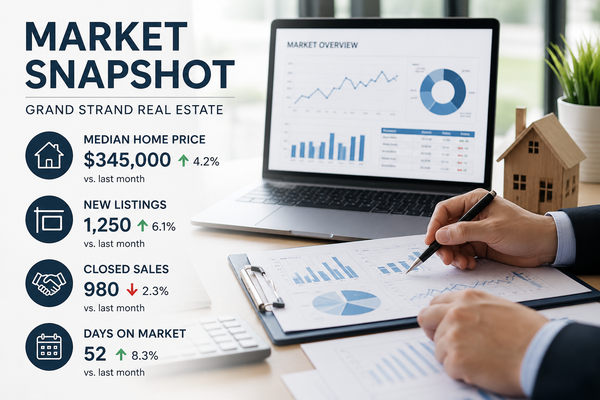
September 2026 Grand Strand Real Estate Market Report

Short Term Rentals on the Grand Strand:What the Numbers Actually Say in 2026

Is Myrtle Beach Headed for a Housing Crash? Here's the Honest Answer

The Grand Strand's Best Kept Secret — Fall Is Here
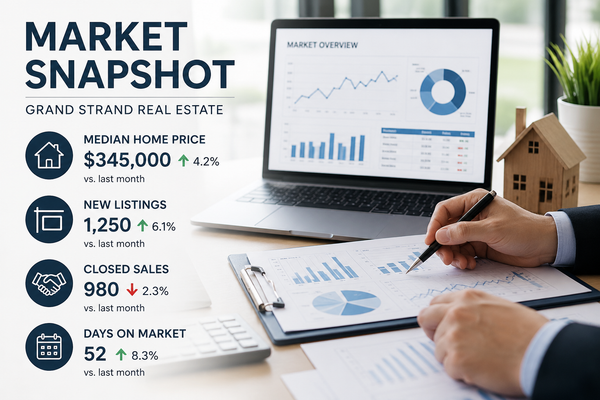
August 2026 Grand Strand Real Estate Market Report

Living on a Golf Course on the Grand Strand: Is It Worth It?

Thinking About Selling on the Grand Strand? Here's What the Market Is Telling You Right Now