

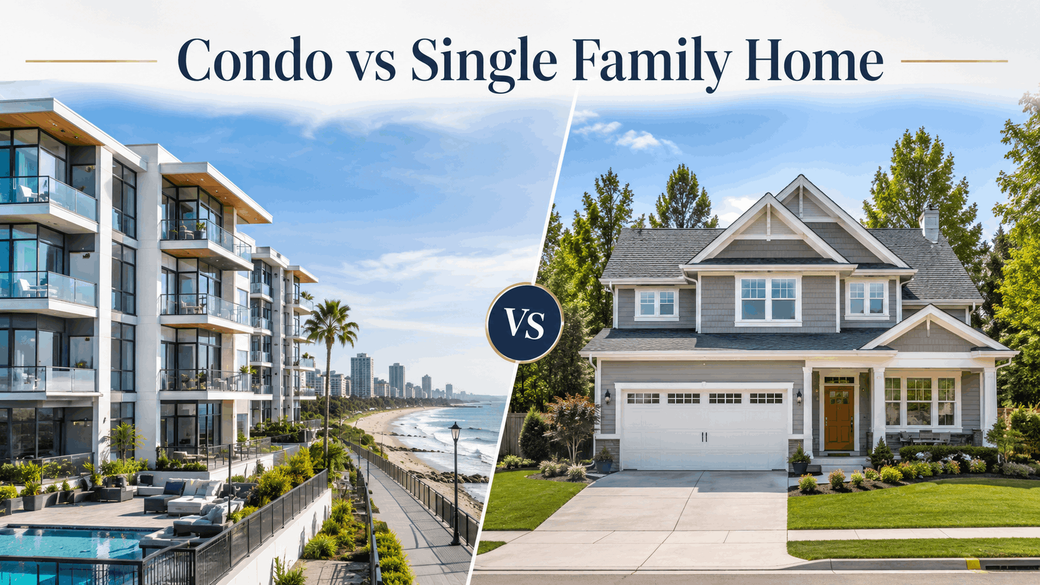
Condo vs. Single-Family Home in Myrtle Beach: Which One Makes More Sense Right Now?
🏠 Buyer’s Guide • Myrtle Beach 2026
Condo vs. Single-Family Home in Myrtle Beach:
Condo vs. Single-Family Home in Myrtle Beach:
Which One Makes More Sense Right Now?
Same zip code, very different market. Here’s what the data says.
Same Zip Code. Very Different Market.
If you’re shopping for a property on the Grand Strand right now, you’ve probably noticed something: a condo and a single-family home in the same area can tell completely different stories. One segment is soft, sitting on the market, and loaded with buyer leverage. The other is holding steady, moving faster, and holding its value.
The difference matters whether you’re buying a primary residence, a vacation retreat, or an investment property. Let’s walk through the data and help you figure out which path makes more sense for your situation.
The difference matters whether you’re buying a primary residence, a vacation retreat, or an investment property. Let’s walk through the data and help you figure out which path makes more sense for your situation.
📊 The Market Right Now — Key Numbers
| • Homes sell in avg. 118 days (Redfin, May 2026) • Average home sells ~4% below list price • 79% of active listings have had price reductions |
• Only 1 offer on average — almost no bidding wars • Single-family prices up ~3%+ year-over-year • Condo median prices down 12.2% YoY (Q1 2026) |
Source: Redfin, Horry County MLS, CCAR Q1 2026 Report · May–June 2026
The Price Gap
💰 What Does Each Property Type Actually Cost Right Now?
The headline numbers are clear: single-family homes and condos are two separate markets on the Grand Strand right now, and treating them the same way is one of the most common mistakes buyers make.
|
🏠 Single-Family Homes
|
🏢 Condos & Townhomes
|
The condo segment is the softest area of the Myrtle Beach market right now. That means lower prices and significant buyer leverage — but it also means more due diligence is required before you buy. More on that in a moment.
Who Buys What
👤 Who Is Each Property Type Really For?
The right choice often has less to do with the property itself and more to do with how you plan to use it. Here’s how different buyer types typically break down:
|
🏡 Lifestyle Buyers
Relocators and full-time residents almost always lean single-family. More space, a yard, privacy, and no shared walls. The Grand Strand’s family communities like Carolina Forest, Conway, and Longs deliver more per dollar than anywhere on the coast.
|
💰 Investors
Investors split by strategy. Oceanfront condos have historically driven short-term rental income. Single-family homes are increasingly popular for investors who want STR income without the HOA restrictions. Location and rules matter more than property type.
|
🏖 Retirees
Retirees are the most split. Low-maintenance condo living appeals to those who want to lock and leave. But many retirees relocating from the Northeast want a real yard and don’t love shared walls. It’s truly a lifestyle decision.
|
The Myrtle Beach market continues to draw a steady stream of buyers from the Northeast, Midwest, and Mid-Atlantic — many relocating for lifestyle, climate, and South Carolina’s favorable tax environment. That inbound migration provides a strong demand floor for both property types.
The Condo Considerations
⚠ What Do You Need to Know Before Buying a Condo in 2026?
Condos can be a great option — but buyers are being much more selective right now, and for good reason. The condo landscape on the Grand Strand has changed significantly in the past few years, and the due diligence required has never been more important.
💳 HOA Fees: The Real Monthly Cost
HOA fees for Myrtle Beach condos typically range from $200 to over $1,500 per month depending on the building, location, age, and amenities. The median for the Myrtle Beach–Conway–North Myrtle Beach metro is around $255/month — but that average masks a very wide range. Standard condos and townhomes in North Myrtle Beach often run $320–$450/month. Oceanfront resort towers can push $600–$1,500/month or more.
🌊 Insurance: The Biggest Change Since 2022
Most Grand Strand oceanfront condo buildings have increased HOA fees 15–30% over the past two years, driven primarily by rising insurance premiums. Some buildings saw their insurance premiums double or triple between 2022 and 2025, and a handful had difficulty securing coverage at all during certain renewal periods. Buyers should treat current HOA fees as a floor, not a ceiling, and budget for continued increases.
🚫 Rental Restrictions: Read Before You Buy
Not every condo allows short-term rentals — and the rules vary significantly building by building. Some HOAs prohibit nightly rentals entirely. Others require minimum stays (7, 14, or 30 days). Still others mandate use of approved management companies. The City of Myrtle Beach and North Myrtle Beach both have their own licensing and permit requirements on top of HOA rules. Always confirm both the HOA rental policy and local zoning before you make an offer on any investment-oriented condo.
🏦 Financing: Warrantability Matters
Many Myrtle Beach condo buildings are non-warrantable — meaning they don’t meet Fannie Mae or Freddie Mac requirements, which limits your financing options and typically means higher rates. This is often due to high investor concentration, ongoing litigation, or HOA financial issues. Ask your lender to check warrantability early in the process before you fall in love with a specific unit.
💡 Before making an offer on any condo, always request: current HOA budget and last 2 years of financials, the reserve study, master insurance declarations (including wind/named-storm deductibles), rental policy, HOA meeting minutes for the last 12 months, and the resale certificate confirming any pending special assessments.
None of this means condos are a bad buy. In the right building, at the right price, they can be excellent. But the gap between a well-run building and a troubled one has never been wider — or more financially consequential. This is where having a knowledgeable local agent becomes genuinely valuable.
The Single-Family Advantage
🏡 Why Are Single-Family Homes Performing Better Right Now?
Single-family homes are the stronger performer in the current Myrtle Beach market. While the condo segment softened, single-family prices have held steady and ticked up slightly year-over-year — and that trend is supported by some clear structural advantages.
|
🔒 Control & Privacy
You own the land. No HOA board approving your paint color or restricting your rental strategy. No shared walls, no elevator waits, no neighbor’s noise through the ceiling. For many buyers, that autonomy is worth a lot.
📈 Long-Term Appreciation
Historically, single-family homes on the Grand Strand have appreciated more consistently than condos. Land scarcity in desirable areas creates a real floor under single-family values that the condo market simply doesn’t have.
|
💵 Simpler Financing
No warrantability issues, no investor concentration limits, no HOA financial reviews required by your lender. Single-family home financing is straightforward, which typically means better rates and fewer transaction surprises.
💸 Lower Holding Costs
No monthly HOA fees eating into your cash flow (or significantly lower ones in communities that do have them). Lower operating costs mean your breakeven point is easier to hit — whether you’re renting it or living in it.
|
Communities like Carolina Forest, Market Common, Conway, and Longs continue to show real strength. Well-priced single-family homes in those areas are moving in 30–45 days, even while the broader market sits at 118 days. That’s a meaningful distinction.
The Investor Angle
📊 Condo or Single-Family for Short-Term Rentals — Which Wins?
The honest answer: it depends on your strategy, your budget, and the specific property. Both can work. But the calculus has shifted.
STR Revenue Benchmarks — Myrtle Beach 2025–2026
| PROPERTY TYPE | AVG ANNUAL REVENUE | KEY CONSIDERATION |
| Oceanfront condo (2BR) | $25,000–$50,000+/yr | HOA fees $200–$700/mo eat into returns |
| Myrtle Beach avg. STR | $43,000/yr (66% occ.) | Supply up 120% YoY; rates still rising |
| N. Myrtle Beach avg. STR | $58,000/yr (61% occ.) | Higher ADR ($259/night); fewer HOA restrictions |
| 4BR+ single-family home | $67,000–$133,000+/yr | No HOA restrictions; higher entry price |
Source: Airbtics, Rabbu, AirROI · 2025–2026 datasets
For investors, the key shift is this: larger single-family homes are increasingly outperforming condos on gross revenue, and they do it without HOA restrictions, warrantability issues, or the building-specific risks that have tripped up condo investors in recent years. A well-located 4-bedroom home near the beach can generate significantly more revenue than a typical oceanfront condo — with cleaner financials.
⚠ Important reminder: STR rules vary by city and HOA. Always confirm both local zoning and HOA rental policies before purchasing any investment property on the Grand Strand. The City of Myrtle Beach and North Myrtle Beach each have their own licensing frameworks.
That said, a well-priced condo in the right building can still deliver solid returns. Oceanfront visibility drives consistent demand, the entry price is lower, and HOA fees that include building insurance simplify operating expenses. The key is running real numbers — not peak-era projections — and verifying the building’s fundamentals before you commit.
Our Local Take
🤝 How We Help Clients Navigate This Decision
We’ve worked with buyers on both sides of this decision — first-time buyers choosing between a condo entry point and a starter single-family home, investors comparing buildings, and retirees figuring out whether low-maintenance condo living is actually worth the HOA fees. The answer is always the same: it depends on your goals, your timeline, and the specific property.
What We Help You Figure Out
| ✔ Which condo buildings have healthy HOA finances vs. hidden risk |
| ✔ Which single-family neighborhoods are still well-priced with upside |
| ✔ Realistic STR revenue projections based on 2023–2025 actuals |
| ✔ HOA rule review — rental policies, restrictions, warrantability flags |
| ✔ True monthly cost comparison (mortgage + HOA + insurance + taxes) |
| ✔ Trusted local lenders who understand both condo and single-family financing |
We’ve seen buyers walk away from deals that looked great on the surface once we reviewed the HOA documents. We’ve also helped investors find condo buildings that outperform the market because the fundamentals — reserves, insurance, rental rules, location — were all solid. The same diligence applies on the single-family side.
No matter where you’re starting from, we’ll make sure you go in with clear eyes and a solid strategy.
No matter where you’re starting from, we’ll make sure you go in with clear eyes and a solid strategy.
Not Sure Which Is Right for You? Let’s Talk It Through.
Tell us what you’re trying to accomplish — budget, goals, timeline, intended use — and we’ll give you a straight answer about which direction makes more sense right now.
No pressure. Just honest, local guidance.
Market data sourced from Redfin, Horry County MLS, Coastal Carolinas Association of Realtors (CCAR) Q1 2026 Report, Airbtics, Rabbu, and AirROI. HOA fee ranges sourced from local Myrtle Beach real estate resources, 2025–2026. All data is for informational purposes only and may change. Consult a licensed real estate professional, lender, and HOA documents before making any purchase decision.
Coastal Carolina Group • Myrtle Beach, SC
For informational purposes only. Not financial or real estate advice.
For informational purposes only. Not financial or real estate advice.
Categories
Recent Posts

Waterfront Living on the Grand Strand: What It Really Costs and What You Actually Get
September 2026 Grand Strand Real Estate Market Report
Short Term Rentals on the Grand Strand:What the Numbers Actually Say in 2026
Is Myrtle Beach Headed for a Housing Crash? Here's the Honest Answer

The Grand Strand's Best Kept Secret — Fall Is Here
August 2026 Grand Strand Real Estate Market Report

Living on a Golf Course on the Grand Strand: Is It Worth It?

Thinking About Selling on the Grand Strand? Here's What the Market Is Telling You Right Now
New Construction Homes on the Grand Strand: The Complete 2026 Buyer's Guide
July 2026 Grand Strand Real Estate Market Report